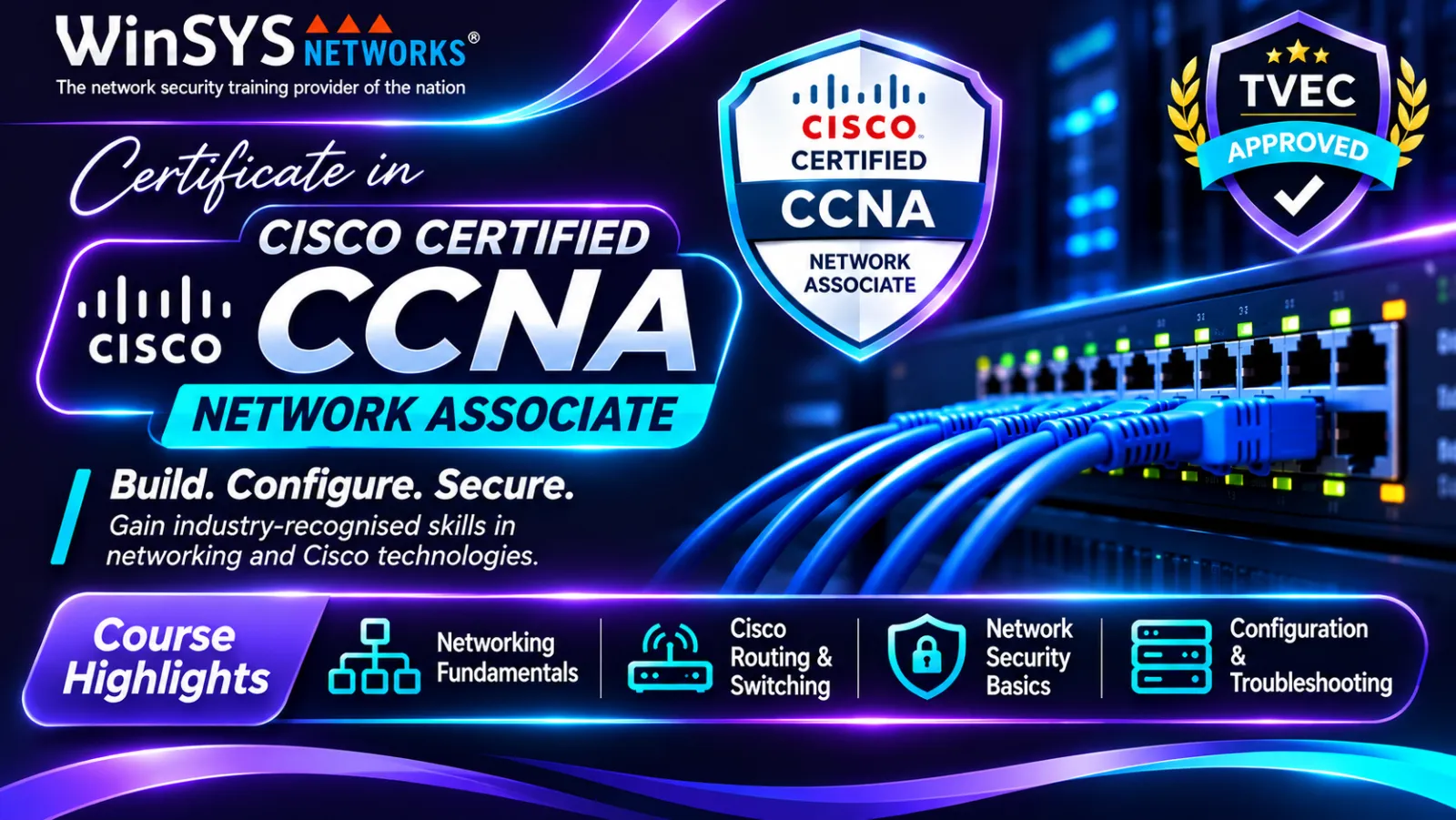
The Cisco Certified Network Associate (CCNA 200-301) course is designed to provide students with comprehensive knowledge and practical skills in computer networking, network configuration, troubleshooting, and infrastructure management. This programme follows the Cisco CCNA 200-301 examination syllabus and covers the fundamental networking technologies required to build, operate, and maintain modern enterprise networks.
Throughout the course, students will gain an understanding of network fundamentals, network access, IP connectivity, and IP services. Key areas include IPv4 and IPv6 addressing, subnetting, VLAN configuration, trunking, EtherChannel, Spanning Tree Protocol, wireless networking, static routing, OSPF, Network Address Translation (NAT), DHCP, DNS, NTP, SNMP, QoS, and secure remote device access using SSH.
The programme emphasises practical, hands-on learning through network device configuration, laboratory exercises, and troubleshooting activities. Students will develop the ability to configure Cisco routers and switches, implement network connectivity, manage network services, and identify and resolve common networking issues.
Upon successful completion, students will have developed a strong foundation in networking technologies and the technical competencies required to pursue Cisco certification and entry-level networking and IT infrastructure career opportunities.
Learning outcomes
Module 01: Network Fundamentals (20%)
Role and Functions of Network Components
Routers
Layer 2 and Layer 3 Switches
Next-Generation Firewalls and IPS
Wireless Access Points
Network Controllers (Cisco DNA Center and WLC)
Endpoints and Servers
Network Topology Architectures
Two-Tier and Three-Tier Architectures
Spine-Leaf Architecture
Wide Area Networks (WAN)
Small Office/Home Office (SOHO)
On-Premises and Cloud Networks
Physical Interfaces and Cabling
Single-Mode and Multimode Fibre
Copper Cabling
Ethernet Shared Media and Point-to-Point Connections
Power over Ethernet (PoE)
Network Interface and Cable Troubleshooting
TCP and UDP Protocols
IPv4 Addressing and Subnetting
Private IPv4 Addressing
IPv6 Addressing and Prefix Configuration
IPv6 Address Types
Global Unicast
Unique Local
Link-Local
Anycast and Multicast
Modified EUI-64
Verifying IP Parameters in Windows, macOS and Linux
Wireless Networking Principles
Wi-Fi Channels
SSID
Radio Frequency (RF)
Wireless Encryption
Virtualization Fundamentals and Virtual Machines
Switching Concepts
MAC Address Learning and Aging
Frame Switching and Flooding
MAC Address Tables
Module 02: Network Access (20%)
VLAN Configuration and Verification
Access Ports and Voice VLANs
Default VLAN and VLAN Connectivity
Inter-Switch Connectivity
Trunk Port Configuration
IEEE 802.1Q Encapsulation
Native VLAN Configuration
Cisco Discovery Protocol (CDP) and LLDP
EtherChannel Configuration and Verification
Link Aggregation Control Protocol (LACP)
Spanning Tree Protocol (STP)
Rapid PVST+ Configuration and Operations
Root Bridge and Root Port Selection
STP Port States
PortFast Configuration and Benefits
Cisco Wireless Architectures and Access Point Modes
Wireless LAN Infrastructure Connections
Access Points and Wireless LAN Controllers (WLC)
WLAN Management Access
Telnet and SSH
HTTP and HTTPS
Console Access
TACACS+ and RADIUS
Wireless LAN Configuration Using GUI
WLAN Creation
Wireless Security Settings
Quality of Service (QoS) Profiles
Advanced WLAN Settings
Module 03: IP Connectivity (25%)
Understanding and Interpreting Routing Tables
Routing Protocol Codes
Network Prefixes and Subnet Masks
Next-Hop Address
Administrative Distance
Routing Metrics
Gateway of Last Resort
Router Forwarding Decisions
Longest Prefix Match
Administrative Distance
Routing Protocol Metrics
IPv4 Static Routing Configuration
IPv6 Static Routing Configuration
Types of Static Routes
Default Routes
Network Routes
Host Routes
Floating Static Routes
Open Shortest Path First (OSPF)
Single-Area OSPFv2 Configuration and Verification
OSPF Neighbour Adjacencies
Point-to-Point OSPF Networks
Broadcast Networks
Designated Router (DR) and Backup Designated Router (BDR)
OSPF Router ID
First Hop Redundancy Protocol (FHRP)
Module 04: IP Services (10%)
Network Address Translation (NAT)
Configuring and Verifying Inside Source NAT
Static NAT and NAT Pools
Network Time Protocol (NTP)
NTP Client and Server Configuration
Dynamic Host Configuration Protocol (DHCP)
Domain Name System (DNS)
Simple Network Management Protocol (SNMP)
Syslog Features, Facilities and Severity Levels
DHCP Client and Relay Configuration
Quality of Service (QoS)
Classification and Marking
Queuing
Congestion Management
Policing and Shaping
Secure Remote Device Access Using SSH
TFTP and FTP Network Services
Eligibility & entry requirements
Applicants should be at least 16years of age.
Basic computer literacy and familiarity with using computers.
Basic understanding of computer hardware and operating systems is an advantage.
An interest in computer networking, IT infrastructure, and network technologies.
Basic knowledge of networking concepts is beneficial but not compulsory.
Students should have the ability to understand technical instructions and participate in practical networking sessions.
Beginners are welcome. No previous Cisco certification or professional networking experience is required.
🚀 Your career pathway
Where the Networking route can take you — from here to a degree and a career.
Possible career roles
🌍 Opportunities in: Sri Lanka · UK · Middle East